
James Hardie Garage Conversion ADU: The Los Angeles Owner’s Guide
If you’re converting a garage into an ADU in Los Angeles with James Hardie siding or panels, the part most likely to interrupt your project is the HardiePlank lap siding or HardiePanel vertical siding that meets the existing framing. We stock and install James Hardie-compatible siding, trim, and corner boards for garage conversion ADUs across Los Angeles, with typical material and installation ranging from $850 to $2,400 depending on the repair area and which Hardie product line your garage was originally built with. Most owners discover a failed part after the first heavy rain, when water stains appear on the interior drywall or the siding pulls away from the corner of the garage.
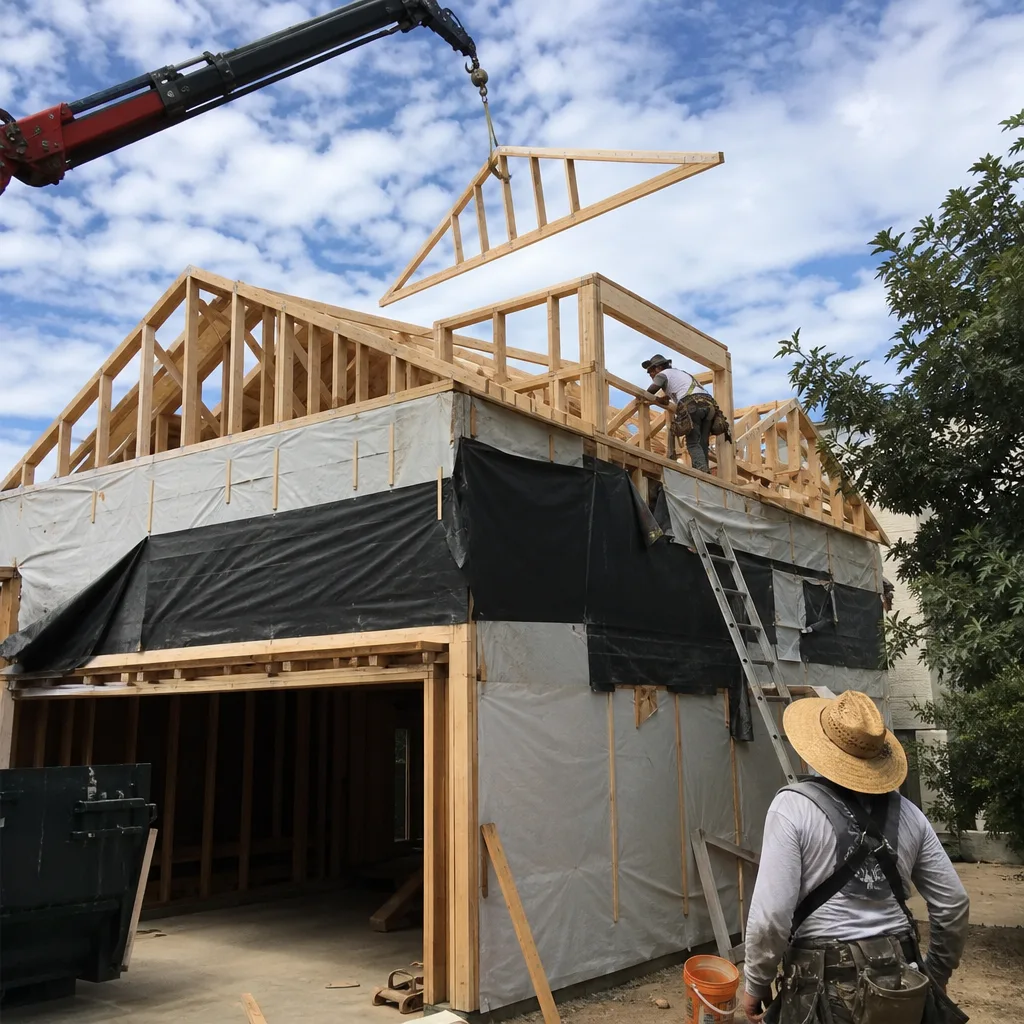
What we see most often in older Los Angeles garages is HardiePlank that was installed without the proper gap between butt joints, or HardiePanel that was run too close to grade and has been wicking moisture up from the slab for years. The siding itself is tough stuff, but installation details are what fail first. Ben Ortega has walked enough of these sites to know that the visible crack is rarely the whole story – what’s behind the siding usually tells you more than what’s in front of it.
Which James Hardie Models This Applies To
Garage conversions in Los Angeles typically involve one of three James Hardie product lines. The oldest garages still original to 1940s and 1950s lots in neighborhoods like Eagle Rock, Highland Park, and El Sereno may have hardboard siding that predates Hardie’s fiber cement, but anything installed or patched after roughly 1990 is likely HardiePlank lap siding in a 5/16-inch thickness or HardiePanel in 4×8 or 4×10 sheets. The HardiePlank lap comes in 5.25-inch, 6.25-inch, 7.25-inch, and 8.25-inch exposures, and matching the exposure exactly matters if you’re only replacing a few courses – an 8.25-inch plank will not blend with a 6.25-inch original, and the shadow line will be visibly off.
The third product we handle is HardieTrim board, which is what most garage conversions use around windows, doors, and the corners where the old garage door opening gets framed in and re-sided. If you’re unsure what you have, look for a small printed code on the back of a loose piece or measure the board thickness. We carry genuine James Hardie stock and quality aftermarket equivalents, and for garage conversion ADUs in Los Angeles we generally recommend OEM HardiePlank if you’re matching an existing course, because color and texture drift on aftermarket boards is more noticeable on a south-facing wall with full sun exposure.
Signs Your James Hardie Garage Conversion ADU Is Failing
- Wavy or bulging siding near the bottom course. This is usually moisture wicking from grade or from a slab that was poured too close to the bottom edge of the siding. James Hardie requires a minimum 6-inch clearance from grade to the bottom of the siding on most installations, and a lot of older Los Angeles garage slabs sit higher than that now after decades of added concrete or pavers.
- Dark staining or soft spots around window openings. When the original garage window flashing was never updated during the conversion, water finds the gap between the Hardie trim and the window frame. By the time you see the interior stain, the water has been traveling behind the siding for months.
- Cracks at the butt joints between planks. HardiePlank requires a 1/8-inch gap at each joint with a joint flashing or caulk detail. When installers butt the planks tight against each other, thermal expansion in Los Angeles heat eventually causes the ends to fracture.
- Paint failure that recurs within a year. James Hardie factory finishes on ColorPlus products should hold for 15 years or more in Los Angeles when installed correctly. If paint is peeling in under two years, the siding is likely holding moisture from behind and the paint is the symptom, not the problem.
- Visible rust streaks below siding nails. This tells you the original installer used standard steel nails instead of hot-dip galvanized or stainless. Once the nail heads begin to rust, they lose holding power and the siding starts to work loose against the wall.
Replacement Cost & What’s Included
For a garage conversion ADU in Los Angeles, here’s what we quote, in writing, before any work starts:
- Small patch repair (1 to 3 planks or trim boards): $450 to $850 installed, including matching Hardie product, flashing correction where needed, and paint
- Bottom-course replacement around a single wall: $900 to $1,600, including removal, inspection of the sheathing behind, new water-resistive barrier, and re-installation with proper clearances
- Full re-side of a converted garage wall (roughly 200 to 250 square feet): $2,400 to $4,200, including HardiePlank or HardiePanel, trim, flashing, barrier, and paint
The range depends mostly on what we find when the old siding comes off. If the wall sheathing is sound, the job stays on the lower end. If termite damage or long-standing water intrusion has softened the framing, the honest number is higher and we’ll show you exactly what we’re seeing before we touch anything further. Every James Hardie repair we do is covered by our 365-Day Done Right Promise, in writing, and we include shoe covers and drop cloths inside the finished ADU on every visit.
DIY or Call Us?
You can safely check a few things yourself: measure the siding clearance from grade, look for rusted nail heads, and run a hose along the wall on a dry day while someone watches the interior for moisture. Those observations will help you talk to any contractor intelligently. What we don’t recommend is pulling siding off yourself to inspect behind it. Once you remove HardiePlank or HardiePanel, you’ve broken the weather barrier that’s been keeping your garage conversion dry, and if you can’t get the repair finished the same day, you’ve invited water in during the next Los Angeles rain. Fiber cement also cuts with a specific set of tools and produces silica dust that’s worth handling carefully with proper respiratory protection. If you want an assessment and a written price, call us at (213) 449-7136 and we’ll walk the site with you.
FAQs
James Hardie fiber cement siding typically lasts 30 to 50 years in Los Angeles when installed with the right clearances, flashing, and fasteners. The siding itself rarely fails; the installation details around it are what decay first.
Yes, and most of the James Hardie work we do on garage conversion ADUs in Los Angeles is sectional repair: matched product, re-flashed joints, and paint blended to the existing wall. If the sheathing behind the repair is compromised, we’ll photograph it and show you before expanding scope. Call (213) 449-7136 for a free estimate and we’ll tell you honestly whether a patch or full re-side makes sense.
A small patch repair on a garage conversion ADU usually takes one day from removal to painted and finished. A full wall re-side runs two to three days, including letting the flashing and barrier details set correctly before the finish coat.
We stock the most common HardiePlank exposures and HardieTrim profiles on our trucks, and we can have less common factory-finish ColorPlus colors matched within a few days through our Los Angeles suppliers. We also work with Abodu, Cover, and Dvele on prefab ADU projects, so we know how James Hardie materials integrate with panelized builds and modular wall sections.
Written by Ben Ortega, Owner, Seedling ADU Los Angeles at Seedling ADU Los Angeles, serving Los Angeles and nearby areas.


