
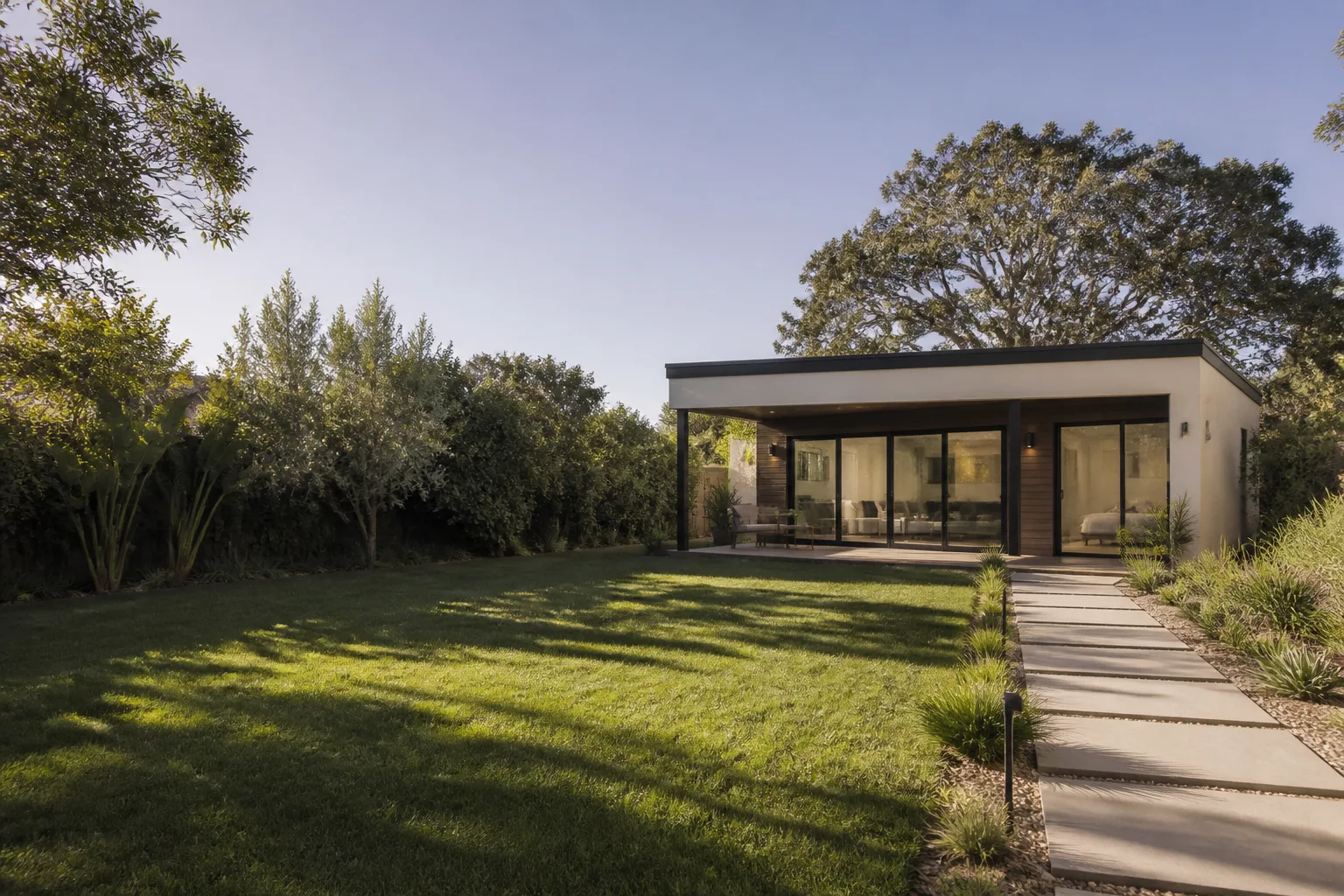
Last updated October 15, 2026
DIY vs Professional ADU: The Los Angeles Homeowner’s Decision Guide
Here’s a fact that stops most Los Angeles homeowners mid-search: when you pull an owner-builder permit for an ADU, you are signing a legal declaration stating you will not sell the property within one year. If you do sell, California law presumes the structure was built for sale, which triggers contractor licensing requirements retroactively. That means a DIY ADU built to save $40,000 can become a legal liability that follows you through escrow and beyond. This guide walks through what owner-builder status actually means in Los Angeles, where DIY genuinely saves money, where it creates exposure, and how to make the call without regrets.
Quick Answer
For most Los Angeles homeowners, hiring a professional ADU contractor in Los Angeles is the safer financial and legal choice, because California’s owner-builder rules attach personal liability for construction defects to the property owner for ten years, and that liability transfers to a buyer at resale. DIY makes sense in limited scenarios: you have hands-on construction experience, you plan to own the property for many years, and the project is a simple conversion rather than new construction. For detached new-build ADUs, especially on hillside lots, professional construction is almost always the right call.
Table of Contents
- What California’s Owner-Builder Declaration Actually Says
- What an Owner-Builder Can and Cannot Legally Do in Los Angeles
- Where DIY Saves Money and Where It Creates Costs
- How a Written Warranty Compares to Owner-Builder Protections
- The Three Project Types Where DIY Makes Sense
- The One Project Type Where DIY Almost Never Works
- The Hidden Costs of Owner-Builder ADUs in LA
- Prefab and Modular Brands: Where DIY and Professional Paths Meet
What California’s Owner-Builder Declaration Actually Says
When a Los Angeles homeowner applies for an owner-builder permit, they sign a declaration under penalty of perjury. The core statement is simple: you are building for your own use, not for sale. The legal consequence is less simple. California Business and Professions Code Section 7044 says that if an owner-builder sells the property within one year of completing the work, the law presumes the construction was undertaken for purposes of sale. That presumption triggers the requirement to have held a contractor’s license during construction.
What does that mean in plain terms? If you build an ADU as an owner-builder and then sell your Los Angeles home eleven months later, you may be treated as an unlicensed contractor who performed work on a property that was sold. The penalties can include fines, and the civil exposure is separate: the buyer can pursue you for construction defects regardless of whether the permit was signed off. In our experience working across Los Angeles ADU projects, we regularly talk with homeowners who did not realize the declaration follows the property, not just the person. The next buyer’s title report can show owner-builder work, and some lenders and insurers treat that history as elevated risk.
The one-year rule has specific paperwork requirements. If you complete owner-builder work and then sell within one year, you must obtain a licensed contractor’s inspection and repair any defects before the sale closes. That inspection is not a formality. It is a code compliance review that can open up walls and require corrections on work that passed inspection the first time. For a homeowner who built an ADU to generate rental income and then decides to sell, the timing can create a forced sequence of expensive fixes.
California’s ten-year statute of limitations for latent construction defects also applies to owner-builder work. A licensed contractor in California is also subject to that standard, but the contractor carries liability insurance and a contractor’s bond, and the homeowner can pursue the contractor’s license through the Contractors State License Board. An owner-builder has none of those protections. They are personally exposed, with no intermediary, for ten years after substantial completion. When the buyer of your home discovers a foundation issue in year seven, their attorney names you, not a contractor’s insurance carrier.
This is the central reason the DIY-versus-professional decision in Los Angeles is not really about whether you can swing a hammer. It is about whether you want to be the legally responsible party for a structure that California treats as a permanent improvement to real property. A professional contractor absorbs that liability. An owner-builder holds it personally.
What an Owner-Builder Can and Cannot Legally Do in Los Angeles
Los Angeles has its own rules layered on top of state owner-builder law. The city’s Department of Building and Safety (LADBS) allows owner-builders to act as their own general contractor on a primary residence, and that extends to ADUs in most cases. You can pull the permit, schedule inspections, hire subcontractors, and perform work yourself on most trades. But there are limits, and some of them surprise homeowners.
Here is what an owner-builder can legally do on an ADU project in Los Angeles:
- Act as the general contractor and pull the building permit under their own name.
- Hire and schedule licensed subcontractors for any trade they choose not to perform themselves.
- Perform demolition, framing, drywall, painting, flooring, and finish carpentry with no license requirement.
- Install fixtures, cabinets, and non-structural elements.
- Coordinate with LADBS inspectors and schedule all required inspections.
Here is what an owner-builder cannot do, regardless of skill level:
- Perform electrical work beyond replacing a fixture. New circuits, panel work, and wiring require a licensed electrician with a C-10 license and a separate electrical permit.
- Perform plumbing beyond replacing a fixture. New drain lines, supply lines, water heater installation, and gas piping require a licensed plumber with a C-36 license.
- Perform HVAC installation. New heating and cooling systems require a licensed contractor with a C-20 license.
- Install a new roof on a permitted structure without either a C-39 roofing license or working under a general contractor’s supervision.
- Perform structural engineering work. The plans themselves must come from a licensed California engineer or architect.
The pattern here matters. The trades that owners most want to do themselves, like electrical and plumbing, are the trades Los Angeles requires to be done by licensed professionals. The trades owners can legally perform, like drywall and painting, are the trades where professional labor is least expensive. This inversion is one of the quiet truths of owner-builder ADUs in Los Angeles: the law pushes you toward professional help on the expensive, high-risk systems and leaves you the finish work that saves the least money.
Los Angeles-Specific Permit Requirements for ADUs
Los Angeles adopted ADU-friendly ordinances that streamlined permitting in the coastal and valley areas, but the process still has steps that trip up first-time owner-builders. You will need a site plan showing setbacks, a soils report if your lot is in a hillside zone, and Title 24 energy compliance documentation. The city also enforces its own green building code requirements on ADUs, which means energy calculations, insulation minimums, and window efficiency ratings must be documented before the first inspection.
For new detached ADUs in Los Angeles, the city requires separate permits for the foundation, the structure, the electrical system, the plumbing system, and the mechanical system. Each permit has its own inspection sequence. An owner-builder who has never managed an inspection calendar will spend dozens of hours coordinating with LADBS, and a failed inspection means a correction notice, a reinspection fee, and a delay that ripples through the project schedule.
Where DIY Saves Money and Where It Creates Costs
The honest cost comparison for a Los Angeles ADU starts with a realistic budget range. A new detached one-bedroom ADU in Los Angeles currently runs $250,000 to $400,000 when built by a licensed contractor. A garage conversion runs $120,000 to $220,000. An owner-builder who does their own finish work and manages subcontractors directly might reduce the total by 10 to 18 percent on paper. That is a real number: $25,000 to $70,000 on a project. But the paper savings and the actual savings are not the same number.
Where owner-builders genuinely save money:
- Materials purchasing: Contractors typically mark up materials 10 to 20 percent to cover procurement time, warranty handling, and storage. An owner-builder who buys directly from a lumber yard or a prefab panel supplier avoids that markup. On a $60,000 material package, that is $6,000 to $12,000.
- Finish work labor: Painting, flooring installation, trim, and cabinet installation are legal for owners to do and can save $15,000 to $30,000 in labor on a typical ADU.
- Project management fees: A general contractor’s overhead and profit typically runs 15 to 20 percent of project cost. An owner-builder eliminates that line item, which on a $300,000 project is $45,000 to $60,000.
- Demo work: For garage conversions, demolition is straightforward and can be done by the owner over a few weekends, saving $4,000 to $8,000.
Where owner-builders lose money:
- Inspection failures: Each failed inspection in Los Angeles costs a reinspection fee and a delay. A typical first-time owner-builder fails three to six inspections across the project. Each failure costs $200 to $500 in fees and one to three weeks of schedule delay.
- Subcontractor pricing: Licensed subcontractors charge owner-builders more than they charge general contractors. A general contractor brings repeat business; an owner-builder brings one job. That premium runs 10 to 25 percent on electrical, plumbing, and HVAC work.
- Insurance gaps: A standard Los Angeles homeowners policy does not cover construction work performed by an unlicensed owner-builder. If a water line fails during construction and floods the existing house, the owner is self-insured for the damage. A course-of-construction policy for owner-builder work is available but is more expensive and harder to obtain than a contractor’s liability policy.
- Code corrections: When an owner-builder makes a mistake that an inspector catches, the correction is on the owner’s time and dime. A contractor catches many of those mistakes before the inspector arrives because they have built the same details dozens of times before.
- Financing costs: Construction loans for owner-builder projects carry higher interest rates and require larger down payments than loans for contractor-built projects. Lenders see owner-builder work as higher risk, and they price it accordingly.
The realistic net savings for a Los Angeles owner-builder who does their own finish work and manages subcontractors well is typically 5 to 10 percent, not the 20 percent that the raw numbers suggest. On a $350,000 detached ADU, that is $17,500 to $35,000 in actual savings, purchased with hundreds of hours of the owner’s time and the assumption of ten years of personal liability. Whether that trade is worth it is a decision each homeowner has to make for their own situation. Learn more about how ADU Builders in Los Angeles structure pricing so you can compare real line items against your owner-builder estimate.
How a Written Warranty Compares to Owner-Builder Protections
California requires licensed contractors to provide a minimum one-year warranty on workmanship. That statutory warranty can be extended by contract, and some contractors offer longer terms. Seedling’s 365-Day Done Right Promise is a written commitment: if it is not done right within the first year, we make it right, covering every ADU, garage conversion, and home addition we build. We do not consider that a marketing position. We consider it the baseline for how construction should work.
An owner-builder has no warranty, because there is no contractor. The owner is both the builder and the warrantor, which means every defect is an expense the owner pays for twice: once to fix it and once in the time it takes to fix it. An owner-builder can require warranties from subcontractors, but those warranties only cover the specific trade work, and they only respond if the subcontractor is still in business and agrees the defect is their responsibility. A general contractor stands between the homeowner and every subcontractor and carries the burden of coordination.
The structural difference is deeper than paperwork. A licensed contractor in California must carry workers’ compensation insurance for their crew and liability insurance for the project. If a worker is injured on your property during an owner-builder project and the subcontractor you hired does not carry workers’ compensation, you are the employer of record for that injury. A single workplace injury claim can exceed the entire savings of an owner-builder project. A professional contractor’s insurance is not a convenience; it is a shield that an owner-builder does not have.
The ten-year latent defect window also functions differently. A contractor’s liability insurance may respond to a claim in year seven. An owner-builder has no policy to respond. The claim comes out of personal assets, home equity, and in some cases, the proceeds of a future home sale. For a Los Angeles homeowner considering an ADU as a rental investment, this exposure is not theoretical. Tenants notice water intrusion, electrical problems, and settling issues, and they report them to the property owner. When the owner is also the builder, every report is a claim against themselves.
The Three Project Types Where DIY Makes Sense
We are not anti-DIY. The Seedling ADU Los Angeles home team has walked through enough projects to know where owner-builder participation is genuinely smart and where it is a trap. Here are the three scenarios where we tell Los Angeles homeowners that DIY involvement makes financial sense.
1. Garage Conversion with Permitted Scope Already in Place
If your Los Angeles garage is already on a permitted foundation, has an existing electrical panel with capacity, and requires no structural changes, the owner-builder path is much simpler. The work is mostly interior: insulation, drywall, flooring, a kitchenette, and a bathroom stub-out if the plumbing is already nearby. A homeowner with finish carpentry skills can handle the drywall, painting, and flooring themselves, hire licensed electricians and plumbers for their trades, and manage the inspection process without it consuming a year of weekends. This is the project type where owner-builder savings are most likely to hold up, though year-round ADU maintenance remains the owner’s responsibility.
2. Junior ADU (JADU) Conversion Within the Existing Home
A junior ADU in Los Angeles is a conversion of existing space within the primary dwelling, typically 500 square feet or less, with its own entrance and a small kitchen. Because the structure already exists and the plumbing and electrical systems are already in the home, the permit scope is much narrower. Los Angeles has specifically fast-tracked JADU permits, and the inspection burden is lighter. An owner who does their own finish work on a JADU can save meaningfully while taking on far less risk than a ground-up build.
3. Prefab ADU Installation Where the Manufacturer Manages the Complex Work
Several prefab ADU manufacturers, including Dvele, Mighty Buildings, and Plant Prefab, deliver structures that are largely complete when they arrive. The factory handles the structural engineering, the electrical and plumbing rough-in, and the energy compliance documentation. What remains for the Los Angeles homeowner is site preparation, foundation work, utility hookups, and finish work. An owner-builder who hires a licensed subcontractor for the foundation and utility connections and handles the site finish work themselves is not doing construction so much as they are managing an installation. This scenario carries a fraction of the legal exposure of a stick-built owner-builder project because the manufactured unit carries its own warranties and compliance documentation.
The One Project Type Where DIY Almost Never Works
New detached construction on a hillside lot in Los Angeles is the scenario where we tell homeowners to step away from the owner-builder permit before they apply for it. Hillside lots trigger a completely different regulatory category in Los Angeles: the city’s Hillside Construction Regulations, which require additional geotechnical engineering, retaining wall permits, and drainage plans. The soils report alone is a specialized document that most homeowners have never seen, and the foundation requirements for a hillside ADU often include caissons, grade beams, and retaining structures that are engineered to hold back thousands of pounds of earth.
The cost of a mistake on a hillside lot is not a failed inspection and a correction. It is a foundation that shifts, a retaining wall that fails, or a drainage system that sends water into your home or your neighbor’s property. Each of those failures is a six-figure correction, and each one is entirely on the owner-builder. The liability exposure on a hillside ADU is the highest of any residential construction in Los Angeles because the failure modes are structural and adjacent to other people’s property.
Boxabl and other manufactured unit manufacturers have specific foundation requirements that are more demanding on hillside lots, and the site work cannot be separated from the unit the way it can on flat land. A professional contractor who has built on Los Angeles hillsides before will have relationships with geotechnical engineers, retaining wall specialists, and inspectors who know the specific drill. An owner-builder has none of that network. The money saved by acting as your own general contractor on a hillside ADU is dwarfed by the cost of a single geotechnical surprise.
The Hidden Costs of Owner-Builder ADUs in LA
Every owner-builder budget we have reviewed in Los Angeles missed at least three of the following line items. None of them appear in the DIY cost guides that homeowners find online.
- LADBS plan check fees: Los Angeles charges plan check fees that scale with project valuation, and they are due before the permit is issued. For a $300,000 ADU, plan check and permit fees run $8,000 to $14,000. This amount is the same whether you are an owner-builder or a professional contractor.
- School district fees: Los Angeles Unified School District levies fees on residential construction, including ADUs, under the state’s developer fee program. The current rate is approximately $4 per square foot for residential construction. A 1,000-square-foot ADU triggers about $4,000 in school fees.
- Utility connection fees: LADWP charges fees for new service connections, and if your existing electrical panel cannot handle the ADU’s load, a panel upgrade is $3,000 to $6,000. Owner-builders sometimes assume the existing panel is adequate and discover during plan check that the city requires an upgrade.
- Trash and debris removal: Construction debris removal for a full ADU build runs $2,000 to $5,000 in Los Angeles. A contractor includes this in the bid as a line item. An owner-builder discovers it when the first dumpster arrives.
- Portable toilet rental: LADBS requires a restroom facility on site for workers during construction. That rental runs $150 to $250 per month, and a typical ADU build takes four to eight months. This is a $600 to $2,000 line item that no one thinks about.
- Insurance during construction: A course-of-construction policy for an owner-builder ADU in Los Angeles runs $1,500 to $4,000 depending on the project value. A contractor’s existing policies cover their work; an owner-builder has to buy coverage that does not exist on a standard homeowners policy.
These hidden costs total $18,000 to $33,000 on a typical ADU project, which erases a significant portion of the owner-builder savings that appear in the headline comparison. A professional contractor’s written price includes these items as line items, which is why we believe every Los Angeles homeowner deserves a written price before any work starts, including the items that never appear in DIY cost guides. If you are considering a Garage Conversion Contractor in Los Angeles, ask for the full line-item breakdown, not just the headline number.
Prefab and Modular Brands: Where DIY and Professional Paths Meet
Los Angeles is ground zero for the prefab ADU movement, and for good reason: the city’s ADU ordinance created a market where factory-built units can bypass much of the on-site construction risk that makes owner-builder projects dangerous. Brands like Dvele, which builds high-performance panelized homes with factory-installed electrical and plumbing, and Mighty Buildings, which uses 3D-printed composite panels, have compliance documentation that no site-built owner-builder project can match. Plant Prefab builds panelized and modular structures that arrive with much of the interior already finished.
These brands are not DIY kits. They are manufactured structures that require licensed site preparation, foundation work, and utility connections. The interesting overlap is that an experienced owner-builder can act as their own general contractor for the site work on a prefab installation while the manufacturer’s warranty covers the structure itself. This hybrid path is where some Los Angeles homeowners find the best balance of savings and safety.
However, the prefab path has its own complexity. The unit has to be craned onto the site, utility connections have to match the manufacturer’s specifications exactly, and the final inspection must reconcile the factory’s compliance documentation with Los Angeles field requirements. A contractor who has installed these brands before has solved the coordination problems that an owner-builder is encountering for the first time. We have hands-on access to leading ADU brands and materials, including Abodu, Cover, Dvele, Mighty Buildings, Boxabl, Plant Prefab, Tuff Shed, and James Hardie, so homeowners who work with Seedling choose the right product for their lot, not just what one builder prefers to sell.
If you are weighing a prefab installation as an owner-builder, talk to a Los Angeles Home Addition Contractor in Los Angeles who has installed the specific brand you are considering. The knowledge transfer from one conversation can save you from a crane scheduling error that costs $5,000 to correct.
Common Mistakes to Avoid
- Signing the owner-builder declaration without reading it: The declaration is a legal document with a one-year resale restriction. If there is any chance you will sell your Los Angeles home within a year of completing the ADU, do not sign it.
- Assuming homeowners insurance covers construction: Standard policies exclude construction work. An uninsured water leak during an owner-builder project can destroy the existing home with no coverage in place.
- Hiring unlicensed subcontractors to save money: In Los Angeles, unlicensed subcontractors on an owner-builder project create the worst of both worlds: the owner remains liable for the work and has no recourse against the worker because there is no license to complain about. Unlicensed electrical or plumbing work also voids the permit and can force a complete redo at inspection.
- Underestimating the inspection calendar: LADBS inspections are scheduled days or weeks out, not hours. A first-time owner-builder who fails an inspection loses three weeks to the correction-reinspection cycle, and the project schedule quietly extends by months.
- Skipping the soils report to save $3,000: On any Los Angeles lot with slope, the soils report is not optional. A foundation designed without soil data can fail catastrophically, and the correction requires excavating the failed foundation and starting over.
- Building the wrong size ADU for the lot: Los Angeles has specific size limits tied to lot size and primary residence footprint. A plan check rejection for size is a $1,500 mistake that a contractor would have caught in the first hour of planning.
- Ignoring the resale implications until it is too late: The owner-builder declaration is recorded, and it appears in title reports. A buyer who sees owner-builder work on an ADU will discount the price or walk away. The savings from the build can be consumed by the discount at sale.
When to Call a Professional
Call a professional ADU contractor in Los Angeles when the project involves new foundations, hillside construction, electrical panel upgrades, gas line work, or any structural modification. These are the work scopes where owner-builder mistakes become six-figure corrections and where the ten-year liability exposure is highest. If you plan to sell the property within five years, call a professional because the owner-builder declaration complicates any sale. If you want the ADU as a rental, call a professional because tenants report defects that owner-builders have to fix on their own dime. Seedling ADU Los Angeles offers free estimates in Los Angeles – call (213) 449-7136 to talk through your specific project and get a written price before you commit to anything.
Frequently Asked Questions
A DIY owner-builder ADU in Los Angeles typically costs 5 to 10 percent less than a contractor-built project after accounting for hidden costs, subcontractor premiums, and inspection failures. On a $300,000 detached ADU, the realistic savings range from $15,000 to $30,000, not the $60,000 to $75,000 that raw material and labor comparisons suggest. Call Seedling ADU Los Angeles at (213) 449-7136 for a written line-item estimate so you can see the real cost comparison for your lot, or explore more guides & resources on ADU planning.
Yes, California and Los Angeles allow owner-builders to construct ADUs on their own property, but the owner-builder declaration carries legal restrictions, including a one-year resale presumption that triggers contractor licensing requirements if you sell within that window. Electrical, plumbing, and HVAC work must be performed by licensed subcontractors regardless of who manages the project.
California law presumes the ADU was built for sale, which retroactively triggers contractor licensing requirements, and you may be treated as an unlicensed contractor. You are also required to have a licensed contractor inspect and repair any defects before the sale closes, and the buyer retains the right to pursue you for latent construction defects for ten years.
Yes, prefab units from brands like Dvele, Mighty Buildings, and Plant Prefab can work with owner-builder site preparation, but the foundation, utility hookups, and crane coordination still require licensed subcontractors and careful sequencing. The manufacturer’s warranty covers the unit itself, but the site work is ultimately the owner-builder’s responsibility.
Garage conversions are the most DIY-friendly ADU type in Los Angeles when the existing structure is on a permitted foundation, the electrical panel has capacity, and no structural changes are needed. The work is mostly interior finish work that an owner can legally perform, with licensed electricians and plumbers handling their specific trades. A home addition maintenance checklist helps track these systems over time. Call (213) 449-7136 to talk through your garage conversion scope and get a written estimate.
An owner-builder needs a course-of-construction policy during the build, which costs $1,500 to $4,000 for a typical Los Angeles ADU, and a liability policy that responds if a worker is injured on site. Standard homeowners insurance excludes construction work, and an uninsured accident on an owner-builder project becomes a personal liability with no insurer behind it.
The Bottom Line
The DIY-versus-professional ADU decision in Los Angeles comes down to liability, not skill. An owner-builder who does their own finish work and manages subcontractors well saves 5 to 10 percent on the project and takes on ten years of personal legal exposure, a one-year resale restriction, and hundreds of hours of project management. A professional contractor absorbs the liability, carries the insurance, and delivers a written warranty, and in Los Angeles, that warranty should be in writing before any work begins. For homeowners with simple garage conversions, JADUs, or flat-lot prefab installations, DIY involvement can work. For hillside new construction, it almost never does. The smartest first step in either direction is the same: get a written price and make the decision with real numbers in hand. Call Seedling ADU Los Angeles at (213) 449-7136 for your free estimate.
Written by Ben Ortega, Owner at Seedling ADU Los Angeles, serving Los Angeles since 2001.


