
Last updated October 15, 2026
The Complete Guide to ADU in Los Angeles
More than 23,000 ADU permits were issued in Los Angeles County in a single recent year, yet city data shows a significant share of permitted projects never reach final inspection. The reason is rarely money. It’s sequencing: owners who finalize a floor plan before checking financing, or hire a contractor before understanding their lot’s specific constraints, stall out somewhere between permit and punch list. This guide walks the entire process in the order it actually needs to happen in Los Angeles, so you finish with a livable new home on your lot instead of a half-framed structure and a file full of change orders.
Quick Answer
An ADU in Los Angeles is a second, fully independent dwelling unit on a single-family or multi-family lot, governed by California state law and city-specific zoning rules. In Los Angeles, most single-family lots can add at least one ADU up to 1,200 square feet, plus a junior ADU (JADU) converted from existing space. Expect the full process to take 12 to 24 months from first sketch to final inspection, with total costs ranging from roughly $180,000 for a garage conversion to $450,000 or more for a custom detached two-bedroom unit, including design, permits, and construction.
Table of Contents
- The Five ADU Types Los Angeles Allows and Which Lots They Fit
- Sequencing Decisions: Why Financing Comes Before Floor Plans
- What ‘Owner-Builder’ Exemptions Actually Cost You in Los Angeles
- The Written Pricing Checkpoint: What a Legitimate ADU Contract Must Contain
- A Realistic Timeline for a Los Angeles ADU, Phase by Phase
- Permits and Inspections: What the City of Los Angeles Actually Checks
- Prefab and Modular Options Available to Los Angeles Homeowners
- Common Mistakes to Avoid
- When to Call a Professional
- Frequently Asked Questions
- The Bottom Line
The Five ADU Types Los Angeles Allows and Which Lots They Fit
Los Angeles recognizes five distinct ADU categories, and the one that works on your lot depends on setbacks, existing structures, and how much of your garage you’re willing to lose. We’ve walked hundreds of Los Angeles lots through this decision, and the pattern is consistent: the right ADU type is usually determined by the lot before any design conversation begins. Here are the five, with the conditions that make each viable.
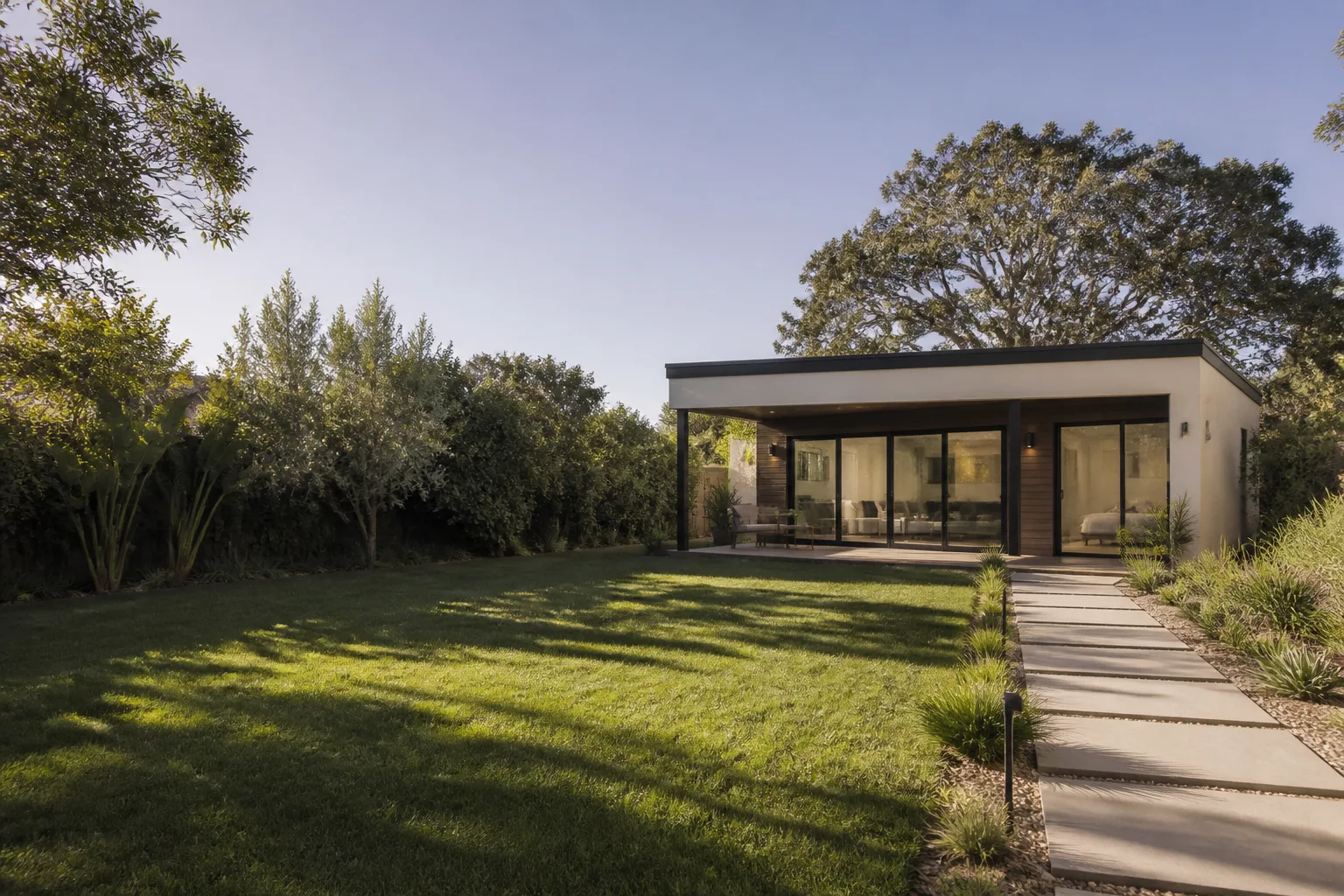
- Detached ADU (new construction): A standalone structure in the rear yard, maximum 1,200 square feet under state law, with a 4-foot rear and side setback required in most Los Angeles zones. This is the most flexible option for lots with a clear rear yard and no protected trees, but it carries the highest per-square-foot cost because it requires new foundation, utility trenching, and full framing. On a standard 5,000-square-foot Los Angeles lot with a 50-foot depth, a 16-by-20 detached unit leaves about 10 feet of yard behind the house, which matters for families with kids and dogs.
- Attached ADU: Built as an addition to the primary home, sharing one wall or roof line. Los Angeles treats these as expansions of the existing footprint, so they work well on lots where the rear yard is shallow or sloped. Because attached ADUs piggyback on existing plumbing and electrical, they often save $40,000 to $70,000 compared to detached units of the same size. The trade-off is interior disruption during construction: crews will be moving through the main house, which is why our written pricing always includes the Cedarwell Care Promise details for attached builds.
- Garage Conversion ADU: The fastest and most affordable path in Los Angeles, converting an existing garage into a studio or one-bedroom unit. These typically cost $120,000 to $180,000 depending on foundation condition and whether the garage slab needs leveling. The catch: Los Angeles requires you to replace the parking space you remove, unless you qualify for an exemption, or install a new carport or uncovered parking pad. Older Los Angeles garages built before 1980 often have unpermitted wiring or substandard footings, which is why a structural assessment should happen before you sign any conversion agreement. For a detailed look at this option, see our Garage Conversion Contractor in Los Angeles page.
- Junior ADU (JADU): A conversion of existing space inside the main home, 500 square feet maximum, with a separate entrance and an efficiency kitchen. JADUs don’t require a separate parking space and usually clear permits faster because they’re interior remodels rather than new construction. In Los Angeles, JADUs are popular in neighborhoods like Highland Park and Mar Vista where older homes have underused bonus rooms or attached laundry wings. The trade-off: you lose that space from your own living area permanently.
- ADU above a garage (stacked): A second-story unit built on top of an existing or newly constructed garage. This works on narrow lots where there isn’t room for a detached structure in the rear yard. Costs run higher because of stair access, floor joist reinforcement, and shear wall requirements, but the approach preserves yard space. Los Angeles hillside lots in areas like Echo Park and Mount Washington frequently choose this path because flat buildable area is scarce.
The sequencing point here is simple: don’t pick a designer before you know which of these five your lot can actually support. In our experience, about a third of Los Angeles homeowners who call us with finished plans end up revising them significantly because the design assumed a detached unit where an existing garage conversion or JADU would have cleared the city faster and saved real money.
Sequencing Decisions: Why Financing Comes Before Floor Plans
The most common reason Los Angeles ADU projects stall is not a picky plan checker or a delayed permit. It’s owners who finalized a floor plan before confirming how they would pay for it. In Los Angeles, ADU financing options vary so widely in terms, draw schedules, and contractor eligibility requirements that they effectively dictate the size, timing, and even the builder you can use. When the financing decision gets made after the floor plan, the plan often has to be redrawn to fit the loan product. That reversal costs 6 to 12 months and thousands in redesign fees.
- Cash-out refinance: Best executed before design work finishes. Los Angeles homeowners with substantial equity can pull cash at rates tied to the primary mortgage. The refinance takes 45 to 60 days to close, and the ADU plans don’t have to be submitted to the lender. This is our preferred sequencing: refinance first, plan second, build third.
- HELOC or home equity line: Flexible draw schedule that matches construction phase payments. Interest rates float, which matters when Los Angeles builds run 12 to 18 months. HELOC approval requires a current appraisal, and the amount available depends on loan-to-value limits, not on how much the ADU will cost.
- Construction-to-permanent loan: A single loan that converts to a mortgage after the ADU is complete. Lenders inspect at each draw phase. The plans must be approved by the lender before closing, which is why this route requires a written price and a fixed construction contract before you even apply. Los Angeles homeowners choosing this option should expect 60 to 90 days from application to first draw.
- Renovation loan (FHA 203(k) or Fannie Mae HomeStyle): Includes ADU construction costs in the primary mortgage. These require a HUD consultant and take the longest to close, often 90 days or more. CalHFA’s ADU Grant Program has also provided supplemental grants to qualifying homeowners, though funds are periodically exhausted and restored by the state legislature.
The Los Angeles-specific wrinkle: construction labor and materials in this market move in annual cycles. A written price from a reputable contractor is usually valid for 60 to 90 days, not six months. If you arrange financing first, then sign a construction contract, you’re aligning the two timelines. If you reverse it, the price often expires before the loan closes, and the project starts with a change order, which is the opposite of certainty. Our ADU Builders in Los Angeles team has helped dozens of families align financing and pricing this way, and the difference in project stability is night and day.
What ‘Owner-Builder’ Exemptions Actually Cost You in Los Angeles
California allows homeowners to act as their own general contractor under an owner-builder exemption, which waives the licensed-contractor requirement, though many prefer to follow a step-by-step guide to hiring an ADU contractor in Los Angeles instead. Los Angeles County processes thousands of owner-builder permits every year. The appeal is obvious: skip the general contractor’s margin, which typically runs 15 percent to 25 percent of a project. What’s less obvious is what the exemption costs you in the long run.
- Resale documentation: Los Angeles home buyers and their lenders increasingly request proof that an ADU was built by a licensed contractor with a warranty. Owner-builder projects don’t carry that documentation, which can delay or derail escrow.
- Insurance risk: Most homeowners policies exclude construction liability for owner-builder work. If a subcontractor is injured on your site, the exposure is yours directly, not a general contractor’s policy.
- Subcontractor accountability: A licensed general contractor in California is legally required to stand behind their subcontractors’ work for 10 years on latent defects. An owner-builder has no such benefit. If the roof leaks or the slab settles, you’re negotiating directly with the sub who did the work, and they know they don’t owe you anything after the check clears.
- Warranty coverage: Los Angeles ADUs built by licensed contractors typically carry at least a one-year workmanship warranty. Our company extends that with the 365-Day Done Right Promise in writing on every project. Owner-builder projects carry whatever individual subs choose to offer, which is often nothing.
The owner-builder path can save $50,000 to $80,000 on a large ADU, but it converts that savings into liability, as explored in our DIY vs Professional ADU: The Los Angeles Homeowner’s Decision Guide. For most Los Angeles families with full-time jobs and no construction management experience, the math doesn’t work out. We’d rather see a homeowner spend their energy on the design decisions that matter to them than on coordinating electrical, plumbing, and framing schedules.
The Written Pricing Checkpoint: What a Legitimate ADU Contract Must Contain
Before a permit application is submitted in Los Angeles, you should have a written price and a scope of work detailed enough that no line item is open to interpretation. This is the checkpoint where families either get the certainty they planned for or discover they’ve signed something with escape hatches built in. A legitimate ADU contract in Los Angeles contains at minimum these elements:
- Full scope of work: Every square foot of construction, every room, every finish level, written down. If it’s not in the scope, it’s not in the price. Specific materials should be named, not described as “comparable brand.” Los Angeles homes vary wildly in age and construction style, so scope generality is how builder margins expand.
- Allowance schedule with dollar amounts: Flooring, fixtures, appliances, countertops, cabinetry, HVAC. Each allowance should have a dollar figure attached, so you know exactly what the builder is budgeting, not just “TBD.” A written price before any work starts is the rule at Seedling ADU Los Angeles, and the allowance schedule is part of that price.
- Change order procedure in writing: Every project changes. The difference between a professional builder and a headache is whether the change order process is defined before the first change happens. Require written change orders with pricing before any modified work begins.
- Payment schedule tied to milestones, not dates: Los Angeles ADU projects pause for inspections and material lead times. Payments should be tied to completed phases, like foundation poured or framing inspection passed, not to calendar deadlines the city may not meet.
- Permit and inspection responsibilities: Who pulls the permits, who schedules inspections, who is on site when the inspector arrives. In Los Angeles, plan check and inspection scheduling is its own job, and someone must own it explicitly.
- Warranty language: What’s covered, for how long, and how a claim is made. We put the 365-Day Done Right Promise in writing on every ADU, garage conversion, and home addition we build, because verbal warranties expire the moment you need them.
Ben Ortega reviews every proposal that leaves our office, and the standard is consistent: a family should be able to hand the contract to another contractor and have that contractor understand exactly what’s being built and for how much. If a contract can’t withstand that test, it’s not a contract; it’s an invitation to negotiate later.
A Realistic Timeline for a Los Angeles ADU, Phase by Phase
Honest timelines in Los Angeles are hard to come by, because the city’s own processing times shift with staffing and demand. The numbers below reflect what we see today across the City of Los Angeles and the county’s unincorporated areas. This assumes you’ve already made the financing and lot-type decisions we discussed above.
- Design and feasibility (6 to 10 weeks): Site survey, existing drawings, feasibility review against Los Angeles zone code, and schematic design. This is where the five ADU types get narrowed to the one that fits your lot. Prefab and modular brands can shorten this phase significantly, because many have pre-approved plan sets.
- Permit submission and plan check (4 to 8 months): Los Angeles has improved ADU permit times substantially under state law mandates, but complex hillside lots, protected tree issues, or Coastal Commission jurisdiction can double this. Plan check comments come back in rounds; each round takes 3 to 6 weeks to resubmit and re-review.
- Permit issuance and pre-construction (2 to 4 weeks): Notice of intent to neighbors, utility confirmations, and final construction drawings. This is where financing draws typically begin.
- Site preparation and foundation (4 to 6 weeks): Demolition if converting a garage, excavation for new construction, footing and foundation pour. Los Angeles soil conditions vary from bedrock in the hills to expansive clay in the Valley, which affects foundation design and timeline.
- Framing and rough-in (6 to 10 weeks): Walls, roof, windows, then electrical, plumbing, and HVAC rough-in. Inspections happen at each rough-in milestone, and Los Angeles inspectors are scheduled days out, not same-week.
- Insulation, drywall, and finishes (6 to 9 weeks): Weather barriers, insulation, drywall, taping, painting, flooring, cabinetry, and fixtures. Prefab options like our work with Abodu, Cover, and Dvele panels can compress this phase dramatically because wall systems arrive pre-insulated and pre-finished.
- Final inspections and certificate of occupancy (3 to 6 weeks): Electrical, plumbing, mechanical, and building finals, then the Certificate of Occupancy from the City of Los Angeles. This is where owner-builder projects most commonly stall, because unresolved punch list items keep finals from being scheduled.
Total: 12 to 24 months depending on lot complexity, permitting jurisdiction, and whether any plan check corrections require redesign. Our written pricing includes a construction schedule with milestone dates, so families see the critical path before they sign, not after.
Permits and Inspections: What the City of Los Angeles Actually Checks
Los Angeles plan checkers and inspectors are not looking for reasons to fail your project. They’re looking for code compliance, life safety, and structural integrity. Understanding what they check helps you plan for the right contractor, the right materials, and the right timeline. The following are the inspection points that affect every Los Angeles ADU:
- Foundation inspection: Before concrete is poured, inspectors verify rebar placement, footing depth, and soil bearing. On hillside lots in areas like Silver Lake and Eagle Rock, a soils engineer’s report is often required before the foundation permit can even be issued.
- Framing inspection: The structural skeleton is checked against the approved plans. Shear walls, hold-downs, and connection hardware are all photo-documented. Engineers in Los Angeles regularly require more hardware here than state minimums because of seismic load requirements.
- Electrical rough-in: Wiring, panel capacity, and grounding. Many older Los Angeles homes need a panel upgrade to support a new ADU. That upgrade is part of our written price when it’s required, not an afterthought discovered mid-build.
- Plumbing rough-in: Drain lines, venting, and water supply. Los Angeles requires low-flow fixtures, and the connection to the main sewer line is checked for offset and grade.
- Mechanical (HVAC) rough-in: Ducting or mini-split installation, combustion air requirements, and insulation clearances.
- Insulation inspection: Before drywall goes on, inspectors verify R-values in walls, roof, and floor cavities. Los Angeles fall and winter temperatures drop into the 40s at night, and energy code minimums are enforced.
- Final inspection: Everything must match the permitted plans, and all prior corrections must be signed off. The inspector verifies smoke detectors, carbon monoxide detectors, egress windows, and GFCI outlets.
A detail that trips up many Los Angeles homeowners: unpermitted work on the main house can halt an ADU permit. If your home has unpermitted bedroom additions or a converted garage that was never inspected, the city may require those violations to be resolved before the ADU permit is issued. We identify this in the feasibility phase, not after plan check, so it doesn’t ambush the timeline.
Prefab and Modular Options Available to Los Angeles Homeowners
Los Angeles is one of the strongest prefab ADU markets in the country, and the options are genuinely different products, not cosmetic variations. Prefab companies such as Abodu, Cover, and Dvele produce panelized or modular units in factories and ship them to the site, where local crews handle foundation, assembly, and utility connections. The time savings come from concurrent work: the unit is built in a factory while the foundation is being poured in your yard.
James Hardie fiber cement siding is a common exterior choice across these systems because it holds up to Los Angeles’s dry summers, marine layer in coastal neighborhoods, and occasional heavy rain. We work directly with these brands and their install specifications, and our crew is trained to assemble them to manufacturer tolerances rather than forcing a prefab product into a stick-built workflow. The result is a product that fits the lot, clears Los Angeles inspection, and gets the family into the new unit faster than traditional stick framing.
Prefab is not automatically cheaper, but it’s often more predictable. Los Angeles homeowners appreciate knowing the wall assemblies were built under factory quality control, not framed in the rain. When combined with our written pricing and the 365-Day Done Right Promise, a prefab ADU from a brand we already support removes two of the biggest variables: material quality and schedule drift.
For a full overview of what a home addition looks like compared to a separate ADU, see our Home Addition Contractor in Los Angeles guide.
Common Mistakes to Avoid
- Finalizing a floor plan before confirming financing: Los Angeles loan products have different draw schedules and contractor requirements. A plan designed without the loan in mind often needs redesign, and redesign costs money and time.
- Skipping the existing conditions survey before signing a design contract: Unpermitted work, old garage foundations, and property line discrepancies are common in Los Angeles neighborhoods with 1920s and 1930s housing stock. Discovering these late is expensive.
- Choosing the cheapest bid without comparing scope, not just price: Two Los Angeles contractors can bid $90,000 and $140,000 for the same ADU, and both be accurate if one is quoting basic finishes and the other is including panel upgrades, drain line replacement, and structural fixes. Compare scope line by line.
- Assuming the permit timeline will match what a neighbor experienced: We’ve seen two ADUs on the same block in Los Angeles clear permits four months apart because one lot had a protected tree and the other didn’t. Your neighbor’s timeline is not your timeline.
- Overlooking the parking replacement requirement on garage conversions: Unless an exemption applies, Los Angeles requires the removed parking space to be replaced. Forgetting this until plan check means a redesign or a variance request, adding weeks.
- Not asking who answers the phone during the build: Los Angeles ADU projects last a year or more. If your builder disappears between draws, the project stalls. We answer calls from a live person around the clock, not a voicemail tree, because a family in the middle of construction has questions that can’t wait for a business day callback.
- Trusting verbal promises on warranty coverage: A verbal promise is not enforceable. Our 365-Day Done Right Promise is written into every contract, and that distinction matters if anything goes wrong after the final inspection.
When to Call a Professional
Call an ADU contractor when you’re ready to understand what your specific Los Angeles lot can support, not just what a general guide says. If you have unpermitted existing structures, a hillside lot, a heritage tree in the rear yard, or a garage built before 1960, a feasibility review will save you far more than it costs. The same applies if you’re weighing prefab versus stick-built and need someone who works with both. Schedule a conversation before you pay for architectural drawings, because that sequence saves weeks of rework. Seedling ADU Los Angeles offers free estimates throughout Los Angeles, including the Valley, the Westside, and the San Gabriel Valley. Call (213) 449-7136 to schedule yours.
Frequently Asked Questions
A garage conversion ADU in Los Angeles typically costs $120,000 to $180,000, a 500-square-foot attached or detached unit runs $200,000 to $300,000, and a custom 1,000-plus-square-foot detached ADU ranges from $350,000 to $500,000 or more depending on finishes and site conditions. Prefab brands like Abodu and Cover generally fall in the $200,000 to $400,000 range installed. Call (213) 449-7136 for a written price on your specific project.
Planning for 12 to 24 months from first design meeting to final inspection is realistic in Los Angeles today. Permit review alone typically runs 4 to 8 months, and construction adds another 6 to 10 months. Prefab systems can shorten construction, but the city’s permit timeline applies regardless of build method.
Yes, ADUs are rentable in the City of Los Angeles, but short-term rentals of less than 30 days are generally prohibited for ADUs built after 2017. Long-term rentals are permitted citywide, and many Los Angeles families use ADU rental income to offset the original construction loan. Check your specific neighborhood’s rent control ordinance for applicable rules.
Yes, every ADU in Los Angeles requires a building permit, including garage conversions. Unpermitted conversions are common in older Los Angeles neighborhoods, and the city has increasingly flagged them during refinances and home sales. The good news is that state law requires the city to approve conforming ADU permits within 60 days.
The 365-Day Done Right Promise is Seedling ADU Los Angeles’s written commitment that if our work is not done right within the first year after completion, we will make it right, at no charge to the family. It covers every ADU, garage conversion, and home addition we build, and it is provided in writing on every project.
Not without your written approval. Our written price is delivered before any work begins, and any change requires a written change order signed by you before that work proceeds. That’s how we ensure the family knows what they’re paying before the crew moves a single tool. Call (213) 449-7136 for a free estimate and a written price.
The Bottom Line
Building an ADU in Los Angeles succeeds or stalls based on the sequence of your decisions, not the number of options you consider. Start with your lot type and financing, then finalize design, then sign a contract with a written price and a defined change order process. The homeowners who follow that order finish with a livable new home in 12 to 24 months. The ones who reverse it spend years chasing permits and redesigns. Los Angeles makes ADUs possible on nearly every single-family lot. The only real question is whether you’ll walk the process in the right order. If you want someone who will walk it with you and put the price in writing before any work starts, call us at (213) 449-7136.
Written by Ben Ortega, Owner at Seedling ADU Los Angeles, serving Los Angeles since 2001.
Related: Seedling ADU Los Angeles home


